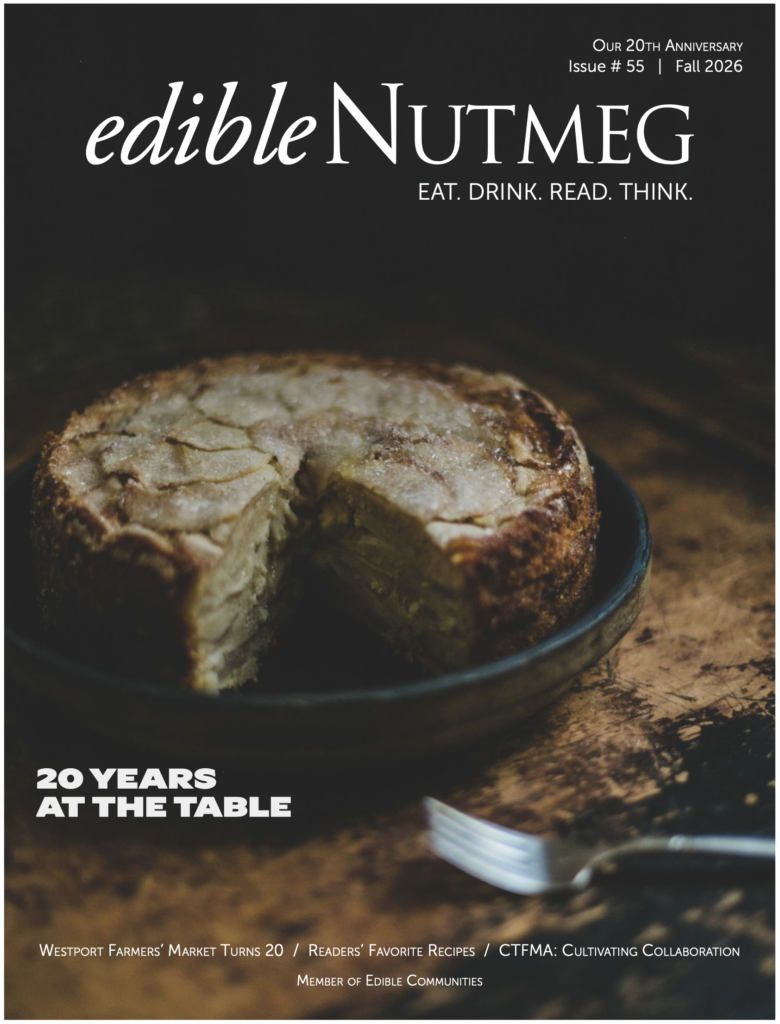
Back in 2006, Robert Lockhart and Mary Adams founded edible Nutmeg and created our first issue (pictured below). In 2015, I inherited the role of producing this publication — 15 years later, we’re proud to bring you our 50th issue.
50 issues is a milestone worth celebrating, and perhaps in a different time and place, we would commemorate it with a look back at some of our favorite stories and recipes. However, with so many concerns looming over our environment and food systems, it doesn’t feel like the right time to revisit the past. Rather, this issue looks to the future and the hurdles that are headed our way, as well as some that are already upon us.
In it, we present articles about (and potential solutions to) food security issues related to both economic inequity and climate change. One of these is the story of the East End NRZ Market & Café, which endeavors to be an oasis in one of Bridgeport’s longest standing “food deserts” by providing fruits, vegetables, and other fundamentally healthy foods in a region long ignored by supermarkets and grocery stores.
We also present two stories about the impact of climate change on our food systems, including one by celebrated author Frances Moore Lappé in observation of a milestone of her own — the 50th anniversary of her book, Diet for a Small Planet. Each of these articles explore the impact that our food choices, both personally and as a nation, have on the environment, and what it means for the future — which increasingly looks precarious and uncertain.
There are no easy solutions, no panaceas, for our environmental predicament, but it is clear that the status quo simply will not suffice. Thankfully, there are things we can do as individuals. Reducing meat consumption is one significant change that any of can make, but rather than implore anyone to “eat less meat,” I will suggest a slightly different option: eat more plants. They’re packed with vitamins and nutrients that are vital to good health, and when farmed in an ethical and sustainable manner, they can help keep our planet’s carbon levels in check. The “sustainable” part here is critical and leads to another thing any one of us can do: reject industrial-scale agriculture and factory farms in favor of small-scale, sustainable, local food production. Small farms have low or even net-negative carbon impact, employ far fewer destructive chemicals and synthetic fertilizers, are proven to produce food with a higher nutrient content, and — perhaps best of all — provide jobs and build both economic and food-related resilience in our communities.
As the holidays approach, I hope you’ll be able to spend time with friends and loved ones, but I also hope you’ll keep the big picture in mind. Thoreau went to the woods to “live deliberately,” but you don’t have to join him there to act with intention. I hope you’ll make choices that are good for our shared future, so that when your children and grandchildren prepare to spend the holidays with their own families, they can do it with the same optimism and excitement that we have so long enjoyed. Perhaps, if we choose wisely, I’ll have nothing to write about when we get to issue #100. Wouldn’t that be a Christmas miracle?
Dana Jackson, Editor & Publisher

Winter 2021 Digital Edition Flipbook